


One of the most important factors in ensuring a building’s safety and longevity is having a solid foundation system. The foundation is the most critical structural element, as it transfers the building’s entire load to the ground and ensures the structure remains stable. For this reason, when determining the type of foundation to be used in construction projects, numerous factors are taken into account, such as soil characteristics, the size of the structure, and the load it will bear. In the construction industry, various foundation systems are used depending on different needs and soil conditions. In this article, we will discuss the types of foundations used in construction, the situations in which they are preferred, and why they are important for structural safety in detail.
What Is a Foundation?
A foundation is a load-bearing structural element located at the very bottom of a building that safely transfers the entire load of the structure to the ground. The strength and longevity of a building depend largely on the proper design and construction of the foundation. This is because the entire weight of a building is transmitted to the foundation through columns, beams, and walls, and the foundation distributes this load evenly to the ground.
When determining the foundation system for construction projects, numerous factors are taken into account, such as the soil’s bearing capacity, the groundwater level, the size of the structure, and the number of stories. For this reason, a soil investigation is typically conducted before the foundation design is finalized. Through the soil investigation, the soil’s structure, strength, and bearing capacity are analyzed, and a foundation system appropriate for these conditions is selected.
Proper foundation construction prevents the structure from settling or sustaining damage over time. It is also one of the most important factors in ensuring the building’s safety during natural disasters such as earthquakes. For this reason, the foundation is considered one of the most critical stages of the construction process.
Today, the construction industry employs various foundation systems—such as isolated foundations, continuous foundations, raft foundations, and pile foundations—tailored to different building types and soil conditions. These foundation types are selected based on the building’s requirements and the soil’s characteristics, thereby contributing to the creation of a safe and durable structure.
What Are the Different Types of Foundations?
The foundation systems used in the construction industry can vary depending on the size of the structure, the load it will bear, and the characteristics of the soil. Selecting the correct foundation type is crucial for ensuring a building is strong and safe. For this reason, foundation types are determined based on the results of soil investigations and engineering calculations. Generally, the types of foundations used in construction are divided into two main groups: shallow foundations and deep foundations.
Individual Foundation
An individual foundation is a type of foundation typically used in small and medium-sized structures. In this system, a separate foundation is constructed for each column, and the column loads are transferred directly to the ground. Individual foundations are generally preferred when the ground’s bearing capacity is sufficient. It is a foundation system frequently used in villas, single-family homes, and low-rise buildings.
Continuous Foundation
A continuous foundation is a type of foundation constructed as a single, uninterrupted strip beneath multiple columns or load-bearing walls. This foundation system is particularly preferred in structures where columns are closely spaced. It distributes the structure’s load over a wider area and transfers it to the ground, thereby ensuring the structure settles evenly.
Slab Foundation
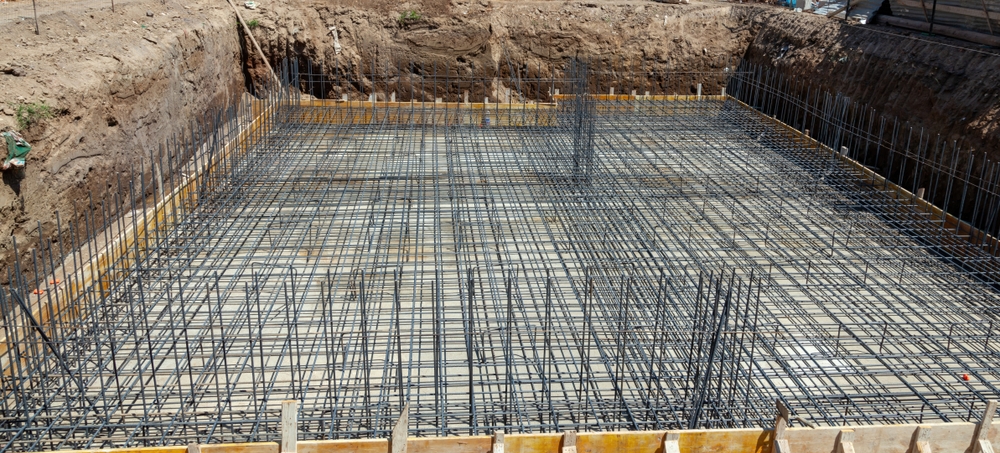
A slab foundation is a foundation system consisting of a wide reinforced concrete slab that covers the entire base of the structure. This type of foundation is particularly preferred in situations where the bearing capacity of the soil is low or where the load needs to be distributed over a wide area. Since a slab foundation distributes the structure’s load over a wide surface area, it also offers significant advantages in terms of seismic resistance.
Pile Foundation
A pile foundation is one of the deep foundation systems used when the upper layers of the soil cannot support the structure’s load. In this method, long, durable piles are driven or installed down to the soil’s more stable layers. Pile foundations are typically preferred for high-rise buildings, bridges, and areas where the soil structure is weak.
The type of foundation to be used in construction projects is determined by taking into account soil conditions, structural loads, and engineering calculations. When the right foundation system is selected, the structure becomes safer, more durable, and longer-lasting. For this reason, foundation selection is one of the most critical stages of the construction process.
What Types of Foundations Should Be Used in Construction?
The type of foundation used in construction projects is of great importance for the safety and durability of the structure. The choice of foundation system is determined by considering numerous factors, such as the soil’s bearing capacity, the size of the structure, the number of stories, the structural load, and the groundwater conditions. For this reason, a soil investigation must be conducted before selecting a foundation, and the appropriate foundation system should be chosen based on the data obtained.
In cases where the soil has a high bearing capacity and the structural load is not excessive, isolated footings or continuous footings are typically preferred. These types of footings are widely used, particularly in low-rise residential projects and single-family homes. By transferring the structure’s load directly to the ground, these systems offer an economical and reliable solution under suitable soil conditions.
In cases where the soil’s bearing capacity is low or the building load needs to be distributed over a larger area, a raft foundation may be a more suitable option. A raft foundation is constructed as a reinforced concrete slab that covers the entire base of the building, distributing the load over a wide area and transferring it to the ground. This feature offers significant advantages in terms of structural safety, particularly in regions prone to earthquakes.
In some cases, however, the upper layers of the soil may not be strong enough to support the structure’s load. In such cases, a pile foundation system is chosen to transfer the load to deeper, more stable soil layers. Pile foundations are typically among the deep foundation systems used for high-rise buildings, bridges, and areas where the soil structure is weak.
In conclusion, the type of foundation used in construction is not limited to a single standard option. The most suitable foundation system must be determined by evaluating the soil conditions and structural characteristics of each project individually. A foundation that is properly selected and installed in accordance with engineering principles ensures that the structure is safe, sturdy, and long-lasting.